Thursday, April 6, 2017

CCL Products - freeze drying competition

Moated businesses catch the savvy of just about every value investor. The idea of investing in businesses that have "sustainable economic moats" has been handed across generations in the quest of compounding capital at supernormal rates of return. A typical definition of an 'economic moat' would be transcribed as 'the ability of a business to maintain competitive advantages over its competitors in order to protect its long-term profits and market share from competing firms.' 
But how exactly do we arrive at defining the moat of a business? On face value, every management claims that their business is different from the other competitor, but is it really so? As Anil Singhvi, the ex-CFO of Ambuja states
" you claim that your cement is different, but it really isn't. you are no one to claim that. let the market perceive it."

Moats arise from two broad pillars - the final product and the cost structure. Royal Enfield is a classic example of a moat that arises from the product , which in turn commands pricing power. On the other hand, moats arising from cost structure are a little more complex to figure out as they don't catch our attention like the sound of an Enfield does. The savvy investor has to dig in a little deeper to truly understand the underlying advantages that arise out of curtailing cost structure in a commodity centric business - Shree Cement and Dalmia Bharat being the prominent names that come to mind. 

In our pursuit of finding companies where the moat resides in the cost advantage and not the product itself we tried analysing commodity centric business with a consumer face. The company we're going to discuss hails from a similar background - an industry brimming with over-capacity, players going out of business everyday and none of the existent players really offering an avenue of incremental value addition(characters reminiscent of an out of fashion commodity business). Lets see if we are able to find a moat in this one.....


First lets read something about the history of the company....

CCL Products was incorporated in 1994 by Rajendra Prasad Challa and Jonathan Feuer. Mr Prasad was earlier the promoter of Asian Coffee which was subsequently sold off to Tata Coffee. On the other hand, Jonathan Feuer has been the CEO of LMZ soluble coffee(one of the biggest names in the world) for 25 years and still represents the brand of CCL in America.

..and now what they do for a living.

CCL Products (India) Limited is engaged in the manufacturing of instant coffee. The Company operates through the Coffee and Coffee related products segment. It is engaged in the manufacture of soluble instant spray dried coffee powder, spray dried agglomerated/granulated coffee, freeze-dried coffee and freeze concentrated liquid coffee. The Company's products include spray dried coffee granules, freeze-dried coffee granules and freeze concentrated liquid. It supplies flavored coffee, decaffeinated coffee, organic coffee, rainforest coffee, fair trade coffee, dual and triple certified coffee, and chicory-coffee mix

Lets now have a look at what the sector has in store for CCL Products....

  • The instant coffee market -
Instant coffee comprises of 34% of the retail brewed coffee consumed around the world, which pegs it at around Rs 31,000cr as of CY16. According to Euromonitor, this is expected to grow to around 35,000cr by end of CY18. Out of the total consumption for instant coffee, nearly 22% comes from the freeze dried variant. The rest is primarily in the form of spray dried

  • The demand for instant coffee - consumption trends
Instant coffee is easy to make as it just requires the powder being put into hot water to make the drink. This breed of coffee is more popular in areas where there isn’t a strong tradition of coffee drinking - as stated by the CCL Management. The biggest consumers of instant coffee include Russia and the Eurozone, whereas the United States, Japan, Korea and China are all opening up as significant markets in the near future. China is converting to coffee drinking from traditional tea drinking population. According to  Euromonitor, China now ranks as the fourth-largest global market for Ready to Drink coffee in terms of volume, and fifth in terms of value, and its growth is largely a result of the attributes it shares with instant coffee, convenience and a malleable flavour profile

  • The Indian scenario -
India consumes around 12,000 tonnes of instant coffee and the magnitude of under-penetration can be understood from the fact that Japan(relatively smaller in terms of population) consumes 35,000 tonnes. Instant coffee market’s size in India is currently at Rs13bn .The major players domestically are Nestle(Nescafe) and Hindustan Unilever(Bru) . Both these brands have significant presence across the value chain with their range of products coming in price bands of 275 a kg upto as high as 4500 a kg. CCL Forayed into this segment only last year. The management of CCL has stated that while these two brands have stagnated, the “continental” brand of the company is growing at ~15% , thereby gaining small chunks of the market from the two established players( revenues of 12 lakhs in FY16)
The inherent advantage that the company enjoys here is that Nestle’s retail price of its freeze dried coffee is at least 50% higher than that of CCL’s offering due to the levy of an import duty of 100% . CCL should be able to gain some traction once its brand is launched on a pan-India basis.

 ....and how they intend on capitalizing it

Expanding capacity

The company has been steadily expanding its capacity over the years - it currently processes 35,000 tonnes(20,000 domestically and 15,000 in Vietnam)  The company plans to increase it by adding a 5,000 tonne freeze dried plant in India , for which land has already been purchased. hectares (~25 acres) of land in Chittoor district of Andhra Pradesh for ~Rs23cr. Other than land, the total estimated capex will be around Rs250cr out of which Rs120cr will be financed through internal accruals and the remaining through debt.

Product innovation

Continental - CCL’s brand of instant coffee has been recently launched in the states of Andhra Pradesh and Tamil Nadu. The management of CCL has stated that the brand has grown at 15% in these markets , thereby eating away at the share of Bru and Nescafe. The passion and urge of management to really promote coffee as the new lifestyle drink of “Young India” gives us confidence in the future of Continental - “We make coffee available for less than 5rs/cup, current price around 12/cup in small towns.”
In the initial roll-out phase, the brand has been placed in small kirana shops and military canteens in certain states of South India. Besides, the entire range is also available on leading e-commerce sites like Flipkart and Amazon

Un chartered territories

Lastly, opening up of the United States as the FSA regulations are passed gives the company enhanced visibility for incremental growth in the coming years. The FSA regulations, which are already in place in Russia and other parts of Europe , prohibit the import of cheap Brazilian and mexican instant coffee into the US. This would present a big market for CCL as the country imports nearly 80 to 85,000 tonnes of instant coffee annually, out of which the company’s share is a mere 2,000 to 3,000 tonnes. Hence, there remains significant ground left to be covered.
 
 We did some fact checking of the management and this is what we got....

  • Capital allocation - is quality of growth being sacrificed at the expense of quantity ?
Capital allocation is central to the success of any business and the management of CCL has been consistently doing that over the years - Every penny invested in the firm has led to incremental rates of return on that invested sum -


The ROE Profile of the company has inched up steadily over the same period - a look at the DuPont analysis shows that incremental return on equity has been delivered on account of higher net profit margins, lower leverage and stable asset turnover -


(The DuPont breakdown of ROE - sustainable Net profit growth leading to superior ROE's)


Which, in turn has led to incremental growth in market cap for every penny re-invested into the business -

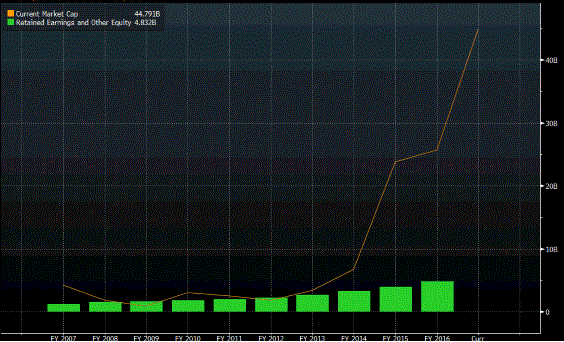
ccl reserves.PNG

ccl.gif

  • Equity dilution
Equity dilution is a potential zone of darkness that investors need to be wary off when analyzing balance sheets. In the case of CCL , there hasn’t been a single instance of the equity base being diluted, except the issue of bonus shares in the ratio of 1:1 in FY’14(Side note - the permissible limit for equity was increased from 20cr to 30cr in 2013.)

Capture.PNG

  • Promoter stake
Have the promoters offloaded stake to fund “philanthropic needs” or to fund their “personal needs” ? An analysis of shareholding of the promoter shows that the promoter group holding has remained constant around 44% consistently over a sustained period of time

  • Subsidiary performance
CCL Products , ‘the parent’  has four subsidiaries - Continental Coffee,Jayanti Pte, Ngon coffee and Grandsaugreen SA. Jayanti Pte. Jayanti is primarily a marketing agent of the company, while Ngon Coffee is the Vietnamese unit which has a capacity of 15,000 tonnes of coffee processing.

The real issue that any minority shareholder would raise questions about is the Swiss Subsidiary - Grandsaugreen. CCL Products initially forayed into Switzerland with plans of setting up a manufacturing unit but due to the extra duty levied on sale, Grandsaugreen became a marketing and packaging outlet for the company. Hence,there was a one time hit that had to be  taken for its change in strategy. This is evident from the negative reserves on the balance sheet
grandsaugreen.PNG

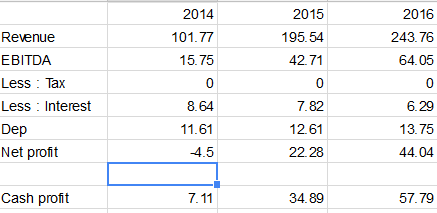
Now, allow me to shift focus to the P/L. The financials of the last three years reveal that although the subsidiary is still in red, it seems to be making some sort of cash profits. (Note - cash profits = net profits - depreciation)
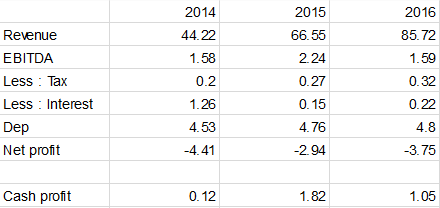
gs.PNG

Capture.PNG
(Vietnamese subsidiary - the plant has been constantly making rapid strides in terms of gaining more and more operating leverage due to increasing capacity utilization . CCL plans to be near full capacity in the near future.)

A look at the financials threw the following conclusions...

  • The company has grown volumes of instant coffee at a 11% CAGR over the past 10 years, which has helped it clock a revenue growth of ~11% in the same period. CCL works on a cost plus model and hence makes it totally insulated from raw material price volatility. Infact, Gross margins for the company have been inching up as well -

\


  • The ‘brand’ of CCL is very evident from the minute details of the Income statement. The company has in fact reduced commission and brokerage by nearly 30% over the past 10 years - a testament to the seller’s market that it operates in

Capture.PNG


  • Incremental Operating and financial leverage at play have ensured that every rupee earned in revenue has led to a 1.25x in EBITDA and a 1.45x in Net Profits


Capture2.PNG

  • As Indian operations near optimum capacity utilization(~80% ) , the onus of incremental operating leverage would now shift to the Vietnam plant which is still just under 50% .  Revenue from capacity expansion would start coming in only after FY’19 from two major projects - the 5,000 tonne freeze dried plant at Chittoor and the 10,000 tonne expansion at Vietnam. In this regard, one has to keep in mind that Vietnam still does only 5-6 blends of spray dried coffee and as capacity ramps up , the management has guided for more complex blends coming out of Vietnam for international markets

All of the operational efficiencies have hence resulted in inherent cash flow generation, year after year
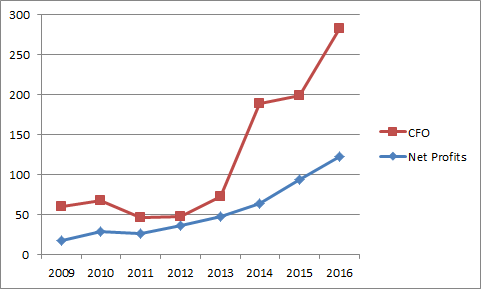

  • The primary driver of consistently enhanced return ratios over a long span of time has been the negligible working capital employed in the business - even running into negative in certain years
(Note that Working capital here excludes cash and short term borrowings.)

CCL WC.PNG


All of that leads to the potential 'economic moat', a wall that CCL builds around itself

In one of the investor conversations, Mr Rajendra Challa mentioned about how the instant coffee market has seen numerous capacities abroad go out of business due to the hyper competitive nature of the sector. He further added that “almost every plant in the world operates at sub 50% capacity.” Within this grim environment, CCL’s consistency and performance down the years truly carve a niche for themselves. The company does over 200 blends of coffee in India and around 6 to 7 blends in Vietnam(which I must mention is still at a nascent stage in its lifecycle.) Getting tea companies to sell its coffee and maintaining its long lasting relationships with key clients are hallmarks for CCL’s truly maverick success down the years

which brings us to the following conclusion...


The planned capacity expansion of freeze dried coffee in India and premiumization of the plant in Vietnam along with increased capacity utilization could lead to higher levels of operating leverage kicking in - and with management guiding for volume growth in the range of 12-15% in the next three years , there rests a case of magnified earnings growth over the medium term. Freeze dried coffee commands a mere 22% of the instant coffee market and as this segment becomes bigger and bigger we could see the wall around CCL become even bigger.


Monday, August 29, 2016

Annual Report Analysis: Aurobindo Pharma 2016

This post is a continuation of our series "Annual Report Analysis". We read annual reports daily and pick out the most important ones where we feel something is happening which might be of interest to others as well. This is in attempt from our side to portray in words what we could decipher from an annual report.
However, one should keep cognizance of the fact that this is an academic exercise on our part to better educate fellow investors and in turn learn from the masters. Here i present you what we found most interesting in Aurobindo Pharma (Auro Pharma) for 2016 and beyond

  • Headquartered at Hyderabad, India, Auro Pharma is the 5th largest Indian pharma company in terms of consolidated revenues
  • Auro Pharma employs more than 15,000 professionals, from over 30 countries
  • Auro Pharma exports to over 150 countries across the globe with more than 87% of its revenues derived out of international operations
  • Auro Pharma has a robust product portfolio spread over seven major therapeutic/product areas encompassing neurosciences, cardiovasculars, gastroenterologicals, antibiotics, anti-retrovirals, anti-diabetics and anti-allergics (well diversified portfolio and not concentrated to any particular segment)
  • Auro Pharma has been ranked as #7 prescription supplier in the US as per IMS total prescriptions dispensed as at March, 2016. The Company is among the top 15 generics companies by sales in Europe (US formulation business contributed 55% to the overall formulation revenue during the year)
  • Auro Pharma is driving growth through several verticals. There is a determined foray into oncology and hormonal products, enzymes, peptides including microspheres, oral contraceptives, steroids, OTC offers, differentiated technology viz. nasal products, inhalers, patches and films (in coming few years Aurobindo will be in every segment to tap every opportunity)
  • Auro Pharma is in the process of developing a wide range of oncology and hormonal products. A new R&D Centre dedicated for generic research in the field of oncology and hormones has been set up at Hyderabad to develop anticancer drugs and hormonal products, both for solid and parenteral dosage forms. (Aurobindo spent 3.38% of revenue (Rs 470 crore vs Rs 347 crore YoY) on R&D in FY16
  • Auro Pharma has over 50 candidates for oncology in the pipeline, with over 15 products pegged for early stages of development (Oncology market set to grow from USD107 billion in 2015 to USD150 billion in 2020). The oral, solid dose formulations sections of oncology & hormone manufacturing facility has been completed and commissioned. The injectable areas of the oncology facility are expected to be commissioned in the later part of 2016
  • A new block to manufacture oncology API is being added keeping the future requirements. The manufacturing facility is expected to be operational in 2017-18 (backward integration to reduce cost and stable source of quality APIs )
  • Auro Pharma is foraying into inhalation and dermatology specialties with a basket of products. Initially, development work has commenced for 2 inhalation products, with another 4 in the pipeline, and 18 dermatology products have been selected for development (the global dermatology market stood at USD20 billion in 2015 and is poised to touch USD33.7 billion by 2022, rising at a 7.73% CAGR from 2015 to 2022)
  • Auro Pharma is striving to become a scientifically stronger company, with newer technologies and difficult to develop specialty generics. Aurobindo is foraying into specialty injection products. Plans are on-going to file the first product in 2017-18. The objective is to launch four identified products, which together account for a market size of around USD 3 billion
  • Auro Pharma is entering the vaccines business with a joint venture for developing pneumococcal conjugate vaccine (Global branded market of more than USD 6 billion and competition is limited)
  • Auro Pharma's subsidiary, Aurohealth manufactures and markets a robust pipeline of innovative liquid and solid dose store brand (OTC) over-the-counter products. The mission is to develop as many OTC products for the US retail market as possible, providing a consistent and reliable supply, at a fair price and of the highest quality
  • Auro Pharma's
  •  newly acquired US based entity Natrol manufactures and sells quality nutritional supplements in the US and select international markets. It offers branded products including vitamins, minerals, and supplements; diet and weight management products; sports nutrition products; and products for hair, skin, and nails  ( Nutraceuticals market is currently at around USD 38 billion and is expected to grow to USD 46 billion by 2018)
  • In terms of the filings to US FDA, a total of 398 ANDAs have been filed by Aurobindo as on March 31, 2016 out of which 251 ANDA approvals (215 final approvals including 10 for Aurolife Pharma LLC, and 36 tentative approvals; Tentative Approvals include 21 ANDAs approved under PEPFAR) have been received. The balance 147 ANDAs were under review for approval. During the year, Aurobindo filed 22 ANDAs, while 49 final approvals were received (strong pipeline to drive revenue going forward)
We view this not as an end result but a starting point in analysing a company, of noting down things which interests us and which we feel could act as a trigger going forward. We will continue this series with many more companies. Some of which are of interest and some are not. However, we want to use this as a measure of enhancing our learning of the subject. Till then Happy Learning.

Sanjoy Bandopadhyay

Wednesday, August 10, 2016

Sundaram Finance Annual Report 2016 Review

This post has been inspired by the fact that Non Banking Finance Companies have ruled the roost in the past few months. I wanted to understand what is cooking in the sector and hence chose to go through the annual report of one of the most respected NBFC in the Indian arena. If something is actually brewing up lets see what they have to say.
So, I picked up the annual report of Sundaram Finance and these are the key points I could notice in that:
  • Global oil prices are expected to remain in the band of $40-50 per barrel but unlikely to fall further(On eye on oil prices shows just how important oil is with respect to India) 
  • Government has accelerated efforts to boost public investments, with a particular focus on roads, railways and power sector, partially reflected in the 69% yoy increase in projects awarded by NHAI(So the efforts of the Government are showing on ground, Nice eh)
  • The Commercial Vehicle (CV) segment led the growth in automotive sector due to two reasons namely; replacement demand and pre buying ahead of mandatory changes in emission norms. Also stable diesel prices provided impetus to truck operators(Highlights that there have been some one off reasons for the recent uptick in the MHCV industry, makes it all the more important to track how the industry moves in FY17)
  • Competition for available business intensified during the year putting pressure on margins(Highlighting the competition is making life difficult, expect some pressure on NIM's)
  • Has already advanced NPA recognition to 90 days ahead of the last date as prescribed by RBI norms(Best in class, expect no negative surprises on asset quality front)
  • Gross & Net NPA stood at 2.08% and .92% making it the best performing portfolio among peers(The figures put even some private banks to shame considering NBFC's have higher cost of funds and effectively lend to the un banked. More so considering the size of the book)
  • The net accretion to fixed deposits this year was Rs 321.56 crores which is the highest in the history of the company(Trust in the management, also some of it could be the effect of rush for yields in a falling rate environment)
  • With most macroeconomic indicators remaining stable, the various measures initiated by Central Government are likely to have a salutary impact on the automotive sector. The continuing thrust on infrastructure and revival of mining activities, coupled with increase in budget allocation for rural sector and fast tracking of irrigation projects augurs well for growth of Medium & Heavy Commercial Vehicle as well as construction equipment. With diesel prices remaining stable, the outlook for automotive sector appears reasonably optimistic(The most important statement, guiding for a better year ahead, highlighting the measures taken. Management sounds optimistic
  • Increased budgetary allocation for rural sector, fast tracking of irrigation projects, increase in farm credit, targeted increase in construction of roads and bridges and implementation of pay commission is expected to augur well for the Indian economy(Confirming the earlier view)
  • Your company hopes to post reasonable growth in its chosen line of business and also continue to explore new, profitable business opportunities(Continuing on the optimistic tone)
  • Competitive pressures in the vehicle financing market are likely to remain high with banks increasing focus on retail lending(Highlighting competitive intensity again. Knowing this it would be a safer option to be conservative as lenders might compromise on asset quality front in a competitive environment to buttress growth rates)
  • Preservation of asset quality will always remain a key imperative. Growth with Quality & Profitability has been underlying philosophy that has guided your company over years and shall continue to do so in future as well(The mantra of Sundaram Finance)
We will keep bringing up more such posts covering the whole NBFC sector to know what are the views of different managements in such an environment. 

Karan Sharma

What bull market, Eh !!

This post is inspired by a lot of noise which is being generated in the investment community over the last one year. Now there are two sides to everything and even now we have one faction of the stock markets who are sounding out caution and ringing alarm bells pointing out the fact that broad market indices are trading at high valuations (Nifty 50 PE: 23.44 & Nifty 500 PE: 26.97) as on 10th August 2016. While there seems to be many advising caution there seems to be this other side which is saying that earnings are on the cusp of growth and hence the P/E which looks expensive on a trailing basis will look cheaper as earnings come out.
To dwell more on this the second group (bull case) made this similar argument last year when markets topped out around March as earnings growth didn't come of and thus tanked the markets. Now, this group again makes the same case. Considering the fact that they turned out wrong once if earnings don't turn up markets wont take it lightly, though i am not suggesting anything, it's just an observation.
However, the purpose of my post was not to make a bull or bear argument. I don't follow indexes or P/E levels hence i am ignorant to these vagaries. The basket of companies i venture in are completely unrelated to indices, ignoring minor similarities in the case of one or two companies. What really caught my attention was some people suggesting the fact that this is a bull market, crap companies are shooting through the roof, there is no sanity, people are not evaluating what they are buying.
This caught my eye because as a regular follower of markets i know that this fact is horribly wrong. Hence, i chose to present my fact with some statistical evidence with the following exercises (This is just a start of a long exercise, I will be doing lot more studies on the similar subject so expect a lot more to come in the following days)

Selected Sensex (Period YTD (year to date) as on 9th August 2016)
  1. Compiled returns data for all 30 companies
  2. Out of 30 companies 8 companies have shown negative YTD returns with the worst being CIPLA at a negative 18.64%
  3. Out of 30 companies 10 have delivered single digit YTD returns with the best being TCS at 9.70 percent while the worst was Coal India at 0.9 percent
  4. So out of a total of 30 companies 18 companies have delivered returns which are not reminiscent of any bull market
  5. Of the 12 companies delivering double digit returns the best is Tata Steel with YTD returns of 45.92 percent while NTPC comes last registering gains of 10.66 percent
  6. All the companies are trading below their 52 week highs with 16 companies trading within a 5 percent band to their all time highs


Selected BSE 500 (Period YTD as on 9th August 2016)
  1. Compiled returns data for all 500 companies
  2. Out of 500 companies 210 companies have shown negative YTD returns with the worst being LYCOS Internet with a negative return of 67.23%
  3. Out of 500 companies 96 have delivered single digit YTD returns with the best being EClerx at 9.85 percent while the worst was Lakshmi Machine Works at 0.09 percent
  4. So out of a total of 500 companies 306 companies have delivered returns which are not reminiscent of any bull market
  5. Of the 194 companies delivering double digit returns the best is Manappuram FInance with YTD returns of 196 percent while Oberoi Realty comes last registering gains of 10.15 percent
  6. All the companies are trading below their 52 week highs with 127 companies trading within a 5 percent band to their all time highs, while 164 companies are trading 20% or greater below their 52 week highs

    I don't know what bull market others have been talking about but what I could infer from the data is that
    1. Market seems to be judging companies based on their performance
    2. With more than 40 percent companies posting negative returns on a YTD basis the argument that crap seems to being bought and junk is getting value is absolutely wrong
    3. What seems to be happening is that junk is getting perfectly valued and the universe of companies posting good results and with good corporate governance track record getting smaller day by day the usual set of companies are getting bid up higher. (Effecient market)
    4. If this was a bull market what market are companies like LYCOS, INOX WIND, AMTEK AUTO witnessing. The shareholders in these companies have seen just bearishness. If I add the JP's & Unitechs and like the list would get endless. 
    5. If even after such judgement and more than 2/3rds of the invest able universe delivering negative returns I wish the much talked about bull market arrives for these companies (for the sake of the poor shareholders)
    Note: If investing was as easy as buying when P/E is 14 and sleeping when P/E is 24 well then people are just reading too many books. 

Karan Sharma 

Saturday, May 14, 2016

Facts on GP Petroleums


Introduction
Gulf Petrochem Group (Global Company) based in the United Arab Emirates (UAE) is a company operating in the downstream and midstream sectors of the oil and energy industry. It has six divisions in Oil Trading and Bunkering, Oil Refining, Grease Manufacturing, Oil Terminals, Bitumen Manufacturing, and Shipping and Logistics. Gulf Petrochem was founded by brothers Ashok Goel and Sudhir Goyel in 1998.
They obtained the rights to commission a refinery in Sharjah’s Hamriyah Freezone alongside a grease manufacturing plant producing lithium base grease.
Gulf Petrochem under its subsidiaries, Gulf Petrochem Energy Private Ltd and Gulf Petrochem Pte Ltd had acquired 72.23 per cent in Sah Petroleums at a price of Rs 15.7 per share in 2014, for a total consideration of Rs 60 crores and renamed it GP Petroleums.
Now I would like to present to you some facts that I have been reading about the company for the past one year. All of it is in no specific order but in bits and pieces which I have tried to present in a flow. Once you read the points below the picture of what I am trying to portray will be partially clear in your eyes
This is what the new management had to say about the historical business of the company and the future business they are planning on venturing into…. "We have so far been traders of bitumen, base oil and fuel oil. Now, we want to graduate to marketers and manufacturers, and India will play an important role in the strategy. We are looking at more acquisitions," S Thangapandian, executive director, Gulf Petrochem”
"We aspire to make Gulf Petrochem Group a global conglomerate operating in oil space and have an integrated portfolio. This acquisition fits into our strategy and also helps us extend our capabilities manufacture, supply and globally distribute a wider variety of products," Sudhir Goyel, Managing Director, Gulf Petrochem Group”
On their investment in India this is what the management had to say….”with a strong government at the helm and with its focus on domestic manufacturing, Gulf Petroleum would like to invest another Rs500 crore in India which will entail entering deeper into the lubricants space with products in automotive and marine industries as well as setting up two more fuel storage terminals to have a total storage capacity of up to 600,000 cubic metres” S Thangapandian, executive director, Gulf Petrochem”
In June 2015 the company announced the launch of REPSOL branded lubricants in India….. “GP petroleum will be securing the formulation of Repsol, blending on behalf of Repsol and marketing the Repsol brand in India. Repsol apart from helping GP in giving technology, formulation, it will also join hands with them in spending money for marketing this lubricant in the country. The spends will be shared 50:50 to start with. While Repsol is strong in two wheelers, it intends to offer products for all the segment of the automotive industry and challenging brands like Castrol, IndianOil amongst others.”
“S Thangapandian, ED at Gulf Petrochem says there is a a good synergy between both the companies Repsol needed a partner, with a good strong presence in the country, the partner who has the financial strength and distribution strength.”
Here is how they intend to sell REPSOL in India… “Repsol currently has around 30 distributors, with warehouses across the country, which are marketing IPOL lubricant for both industrial and automotive segment. The company has more than 2000 dealer counters across the country, which will start selling Repsol lubricant. India will also be the feeder point for the SAARC region for GP-Repsol.”
The Indian lubricant market is intensely competitive but is one of the few sectors which is on a growth path, both on the quality and quantity front. A separate dedicated team and network will service the Repsol brand in India,” said Sudhir Goyel, managing director, Gulf Petrochem Group. Repsol’s products come with added benefits of intense R&D and close association with Honda in Moto GP, which will cater to the newly emerging premium and top end segment across markets in the country.
Repsol will launch the full range of products in Indian market. This year, the company plans to introduce a range of products including, synthetic, synthetic blend and premium mineral base oil products to cater to two wheelers, passenger cars and heavy duty vehicles for the Indian market. Further an exclusive two wheeler premium mineral oil product for the fastest growing segment, ie scooters. 
Marketing initiatives GP Petroleums has roped in Suresh Raina as the brand ambassador for marketing brand REPSOL in India
On sector potential this is what the management had to say…. “While the global lubricant market is flat, the 2 million metric tonne Indian lubricant market is growing at 2.5-3%, and within that the automotive lubricant market, which makes up for 52% of the overall lubricant market is growing at 6%. The partners have set themselves a target of achieving 5% automotive lubricant market by the end of the decade and if GP-Repsol achieves that India will be the second largest lubricant market for Spanish lubricant maker with a production of 50,000 metric tonne in India”
Now I feel the sectoral outlook for automotive lubricants seem to be very positive and here is why. This is what another global behemoth, Petronas had to say… PETRONAS Lubricants International (PLI) today officially launched its state-of-the-art lubricant blending plant in Maharashtra Industrial Development Corporation (MIDC) Patalganga. The USD50 million-plant investment is an essential driver that will help propel PLI's position as a formidable lubricants player in India. The new plant - constructed on 25 acres of industrial land at Patalganga MIDC - with an estimated production output of 110 million litres of lubricants, is expected to commence operations by end 2017.”
"PLI has very aggressive ambitions to be amongst the world's top lubricants player by 2019. India is without exception a very important market for us here in the Asia region and we are confident of the potential ahead of us. Therefore, we have embarked on a solid growth plan to accelerate our business here in India, starting with investments into the new plant that is equipped with world class lubricants blending facilities and equipment, highly automated production line, and increased storage tanks. We have also embarked on a new route-to-market approach that will see us transform the way we do business with our distributors and retailers in the high-street business," said Giuseppe Pedretti, PLI Regional Head of Asia.”
Launching REPSOL branded lubricants in India…. As the management mentioned in June 2015 when it first announced partnership with REPSOL to sell lubricants in India, Last year, GP Petroleums and Repsol SA entered into a strategic partnership under which GP Petroleums has the exclusive right to manufacture and market Repsol’s line of lubricants in India. Thangapandian Srinivasalu, executive director at Gulf Petrochem Group, said the company is targeting at least 5% market share in India’s lubricant market.
Deal contours and future plans…. GP Petroleum, which in 2014 acquired SAH Petroleum in India is a modest player in the domestic industrial lubricant space with its IPOL brand through this partnership with Repsol wants to build its position in the thriving automotive lubricants market. Apart from manufacturing Repsol lubricants at its existing plants in Vasai and Daman, GP Petroleum is also planning to set up a separate 1,00,000 tonnes plant on the outskirts of Pipavav with an investment of Rs 125 crore
S Thangapandian, ED at Gulf Petrochem says there is a good synergy between both the companies Repsol needed a partner, with a good strong presence in the country, the partner who has the financial strength and distribution strength.
“We already have a partnership with Repsol as traders, we are big traders out of UAE, we are a big trader for base oil, this relationship got extended to his partnership here,” he said.
“We know that this relationship is a starting point, as things move forward, there are lot of things that we can do together. It is an initial phase, so first you start understanding each other, the culture, plus-minuses. I don’t rule out anything. We have been both open about that, as we move forward, we will decide,” added Thangapandian. India will also be the feeder point for the SAARC region for GP-Repsol.
Through the above statements I have tried to put forward my understanding of what has been happening with this company GP Petroleums, listed on the NSE & BSE over the past 18-24 months. What interested me most about this company was when I got to know of their partnership with REPSOL to sell automotive lubricants under the REPSOL brand in India.  Let’s see how the events unfolded over the past one year….
·       Gulf Petrochem acquires SAH Petro in 2014 from erstwhile financial investor Navis Capital who exited after a loss on their investment of 5 years.
·       Over the course of the year company bought over the stake from promoters “Sah Group” taking their shareholding to over 70 percent
·       In June 2015 GP Petroleums (name changed from Sah Petro) announces a collaboration with REPSOL to sell lubricants in India, launch slated within a year
·       In April 2016 GP Petroleums launches REPSOL branded lubricants in India with Suresh Raina as brand ambassador


Now in the above four points I have tried to summarize whatever has happened with this company over the last 18-24 months. Below I mention few aspects which I find interesting about GP Petroleums
·       Gulf Petrochem, promoters of GP Petroleum is owned by Indian origin NRI’s based in the UAE and is a USD 2 billion group. They have created this empire in the last 18 odd years which speaks a lot about their capabilities
·       Existing business is most suitable as it helps them in access to base oil at cheap rates and also a deep understanding of the automotive lubricants market (partnership with REPSOL) which is very famous in the two wheeler circuit because of its long standing association with HONDA in Moto GP
·       The Indian automotive lubricants market is a highly lucrative one with the leader Castrol clocking operating margins in the region of 25-30%
·       Gulf Petrochem & REPSOL SA are USD 2 billion & EUR 16.5 billion companies who have partnered to launch REPSOL branded lubricants in India, so there is comprehensive financial muscle behind a company which has  a market capitalization of just USD 45 million

Now let’s dive a little deeper into the past history of GP Petroleums, earlier known as Sah Petro. Sah Petro sells lubricants under brand IPOL. The brand mainly sells in the Commercial Vehicle segment and has a presence in the Indian markets since a long time. However, even though the Indian automotive lubricants market is an attractive space IPOL hasn’t been able to make any inroads in the segment so far. A look at the company financials will tell you how poor has the company been performing over the last few years


·       Over last 4 years there has been no meaningful sales growth for the company. This is all the more surprising considering the company has been spending close to 4% of sales on advertisement & promotion. In fact, sales have trended lower. Need to verify the authenticity of the payments being done on A&P
·       Even though raw material costs have come down over last two years there have been no visible improvement in raw material costs, staying close to 81% of sales in 2015 which is highest for the last 5 years
·       The most interesting aspect is the interest costs. Even though the company has no visible debt it paid an amount of close to Rs 10 crores as interest payments which is around 2.5% of sales
·       As expected profits have gone nowhere over the last 5 years. In fact it has posted a cumulative profit of only 15 crores over the last 5 years
From the above points it is somewhat clear that the erstwhile management had been playing with the books of the company and was not interested in doing business.
Since the new management has taken over they have been pursuing the cleaning of the books of accounts. This is visible from the changes witnessed in the 2015 balance sheet of the company. If one checks the annual report for 2015 we can see that inventory has been written down by Rs 40 crores, debtors by 27 crores and creditors by Rs 80 crores
The interest payments over the years have been forex losses over unhedged acceptances. This went up to almost Rs 29 crores in 2012, 7% of sales. From what could be seen in the annual reports of prior years, the company did not hedge its payables and hence huge losses on forex exposure. Now, in the annual report for 2015 we see more than 50% of payables being hedged which should bring down forex losses to a great extent. In fact if it hedges its creditors completely net margins can go up by 200-300bps
Advertisement & Promotion (A&P) constitutes 3-4% of sales which we see as being clearly inefficient as it has had no material impact on sales. With a new management stepping in we believe this amount will be better utilized to improve sales over the next few years
Days of receivables have seen a considerable improvement in 2015 coming down from over 140 days to 118 days. That should aid working capital requirement
Thus, we can see that even without REPSOL, a better management can make the company profitable and back to normal course of business as witnessed from the improvement in quarterly results

·       9MFY16 profits are close to Rs 8 crores which is almost 50% of cumulative profits over last five years
·       With a lot to be done on efficient procurement of base oil & forex losses there is significant scope for improvement over the current scenario.
·       With addition of REPSOL brand to the cluster one can only wonder what the balance sheet & income statement will look like over the next five years
·       For now, we are waiting for the final quarter results for FY 16 and to have a look at how the balance sheet pans out for this year
Recent developments with GP Petroleums
·       Mr. Hari Prakash Moothedath has been appointed as the "Chief Executive Officer" of the Company w.e.f. December 23, 2015 in place of Mr. K. Murali, who has resigned from the post of "Chief Executive Officer" of the Company with immediate effect.
·       Appointed PricewaterhouseCoopers as internal auditors of the company
·       Mr. Jagdish G. Nagwekar has been appointed as the Chief Financial Officer of the Company in place of Mr. Dhiraj Sharma, who has resigned from the post of CFO with effect from August 05, 2015 under section 203 of the Companies Act, 2013
·       CRISIL upgrades long term & short term ratings of the company


Here is what CRISIL had to say while affecting a rating upgrade…
CRISIL ratings on the bank facilities of GP Petroleums Limited (GP Petro; part of the Gulf Petrochem Group) continue to reflect GP Petro's strategic importance to parent  Gulf Petrochem FZC, Hamriyah Free Zone (GPFZCH; rated 'CRISIL A-/Stable/CRISIL A2+'), and operational and financial benefits derived from association with the Gulf Petrochem group. The ratings also factor in GP Petro's healthy financial risk profile as reflected in its healthy capital structure and debt protection metrics. These strengths are partially offset by modest scale of operations in the highly competitive lubricants industry, and susceptibility to volatility in foreign exchange (forex) rates.
CRISIL believes GP Petro will continue to benefit over the medium term from its strategic position as the flagship entity of the Gulf Petrochem group's Indian operations, and from its improved business risk profile. The outlook may be revised to 'Positive' in case of considerable improvement in profitability, leading to better debt protection metrics, or substantial increase in revenue along with steady working capital cycle. Conversely, the outlook may be revised to 'Negative' if financial risk profile weakens because of large debt-funded capital expenditure or increased financial cost. The outlook/rating may also be revised in case of any revision in the outlook/rating of GPFZCH.
Now all of this has got me interested into this small company, which is listed on the Indian bourses. I have tried to analyze all the above points and happenings with the company and present my facts below
Final outlook on GP Petroleums
·       Gulf Petrochem has acquired majority stake in the company taking stake to 72.3%. Possibility to increase stake further remains limited as only a minor amount is left from the cap on promoter holding
·       They have changed the management, brought in the brand REPSOL and roped in Suresh Raina as brand ambassadors, which shows that they are serious about this business. Also the fact that automotive lubricants is a huge market in India with a market potential of over 2 million metric tonne by volume and growing at a rate of 2-3% p.a
·       Since the management change the first year has been used to clean the books, get the house in order and then prepare for future growth which should start coming in once REPSOL hits the markets
·       REPSOL has been launched in April, 16 and hence we should start seeing the numbers from REPSOL in the P/L from end FY 17
·       REPSOL’s global association with Honda makes us believe that the brand can have a huge potential in India if used effectively. Also, with Honda being a major player in India, any association between the two in the Indian markets can be a wonderful opportunity
·       GP Petroleums has the dealership network of over 2000 dealers through which it can easily channelize REPSOL in the Indian markets.
·       REPSOL being a global renowned brand, we believe the realizations per litre for GP Petroleums should start to increase and as raw material for this product is just base oil which is same for all companies, any increase in realization could add significantly to the margins
·       Even with a global brand in the kitty, the past performance of the management makes us confident in their ability to manage the company well in the future. There have been no known cases of financial irregularities against the promoters and with the parent being a USD 2.5 billion dollar company we can be rest assured of financial assistance for the Indian subsidiary
·       The ratings upgrade and the subsequent increase in borrowings limit increases the assurance that rating agencies like CRISL have also a positive view on the prospects of the company
·       What looks most attractive to us is that here we have a company with a global brand in kitty, backed by a strong promoter, no known case of financial irregularity, very small in size (Market capitalization of just USD 45 million) and entering into a sector with a huge potential
·       The above factors combined makes the company a very attractive proposition at current prices
Risks
No company is without inherent risks and here also there remain a few risks to consider
·       REPSOL has just been launched and we are estimating that it will be a success like Castrol in the coming five years. That may not transpire as the Indian market may not take to the brand so well
·       Even if the brand starts to do well, the management can be a poor capital allocator and squander the cash flows generated
·       We don’t know a lot about the performance of the company. Every quarterly result will present us with an improved picture
·       At this stage it’s difficult to estimate the true value of the company as it depends on many variables taking place. However, this is why we believe we are getting the company at these valuations.
·       Though I have tried to gather information about the new promoters to find out their intentions it is not a process which ends and hence one has to keep looking for signals from the management on this front, especially on the capital allocation side
Disclaimer: I have holdings in the company GP Petroleum and I am not advocating any investment in the same. I am not an investment advisor. This is an educational post and I have just tried to assimilate facts and present my view on the above. I have no targets or future price in mind. This should not be construed as an investment advice. It’s just an educational post where I invite others to point out holes in my analysis so that we can become better investors